It's not often that I come across a new word (forgive me if this sounds like bragging, but it is more to do with my choice of reading material rather than my 'extensive' vocabulary), so when I do find a new word it's like coming across an antique at a car boot sale.
The word I learnt yesterday was esurient, found on page 103 in Kevin Hearne's novel 'Hounded' (published by Orbit in 2011): "I felt completely restored, albeit dreadfully thirsty and a bit esurient".
Esurient is an archiac expression that means hungry (appropriately used in the novel as the character is an immortal Druid) and comes from the Latin esurire and esuriens, to hunger. It's so archiac, that the word does not appear in many dictionaries. I had quite a hunt to find it's meaning.
So, amaze your friends and family. Next time someone asks you, "Are you hungry?", you can reply "Yes, I'm quite esurient", and watch their faces as they try to work out what you just said...
Sources:
The Concise Oxford Dicitonary of Current English (1995), Clarendon Press.
Hearne, Kevin (2011) Hounded, Orbit.
Juliana
Thursday, 12 January 2012

Sunday, 27 November 2011
Concrete and Cement
Hands up, who knows the difference between concrete and cement? Not me. I kept getting them mixed up, so I decided to find out their etymology and then hopefully, I'd remember which was which. So...cement is a manufactured powder, which, when mixed with aggregate, sand and water makes concrete.
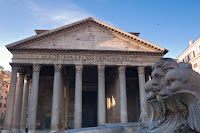
 However, a form of concrete was used by the Romans who called it opus caementicium, a mix of lime and stone rubble. One superb example of Roman architecture that used their form of concrete is the Pantheon in Rome with it's amazing dome (see the pictures on the left). The Byzantines also used concrete, but the process was lost or forgotten in England until the eighteenth century. The architecture Smirke used concrete when he built the British Museum in 1823 (see below right). So the next time you visit, take a look at this structure. It has housed some of the treasures of Britain for over two centuries. This does not compare to the Roman Pantheon, but it's a bit closer to home...

The word cement is known from before 1300, and is spelt cyment in Kyng Alisaunder. Later, circa 1330, it became siment, from the Old French ciment, which came from the Latin caementum, which meant rough stone, rubble. The spelling that we know today appeared before 1398, which also came from French. Thus, the word was pronounced differently, with the emphasis on the first syllable. Only recently, in the last century or so, has the emphasis shifted to the second syllable. In English, cement has always described a pasty mixture that hardens into a rocklike substance. Originally, though, cement was the rubble that was mixed with lime and water to form mortar.
Concrete has a longer history, with more varied and subtle meanings. It has only been used as a noun since 1834, where it described a mixture of sand, gravel and water with cement to form a solid mass. Nonetheless, concrete was used as an adjective from before 1398, to denote an actual substance rather than a quality. This meaning came from the Latin concretus, which was the past participle of concrescere - to harden, solidify. Primarily a term used by logicians and grammarians to contrast with abstract, from the 1600s it became to mean real or particular (that is, not abstract or general) and can be found in Milton's poems and Carlyle's philosophical works.

 However, a form of concrete was used by the Romans who called it opus caementicium, a mix of lime and stone rubble. One superb example of Roman architecture that used their form of concrete is the Pantheon in Rome with it's amazing dome (see the pictures on the left). The Byzantines also used concrete, but the process was lost or forgotten in England until the eighteenth century. The architecture Smirke used concrete when he built the British Museum in 1823 (see below right). So the next time you visit, take a look at this structure. It has housed some of the treasures of Britain for over two centuries. This does not compare to the Roman Pantheon, but it's a bit closer to home...
Sources:
Chambers Dictionary of Etymology (1988), Chambers.
Curl, James Stevens (1989) Oxford Dictionary of Architecture, Oxford University Press.
Images:
British Museum (date unknown) [online], www.jhstudioglass.com/British-Museum-Designs/ (accessed 30th September 2011)
Pantheon (2011) [online], www.gothereguide.com/pantheon-rome-place/2011 (accessed 30th September 2011)
Monday, 14 November 2011
Tamping
It's time for a vocabulary lesson.
Today's Wenglish word is tamping. According to Webster's Dictionary, tamping is the act of plugging up a hole prior to blasting with dynamite. However, in Wenglish it has a very different meaning - very angry. For example: " 'E was tampin' when 'e 'eard about what 'ad 'appened!". For more emphasis, you can say " 'E was tampin' mad when 'e 'eard what 'ad 'appened!"
To differentiate from the word in Webster's Dictionary, it's all in the pronounciation. You place the emphasis on the first syllable with a slight pause after the 'p', ie. TAMP'ing.
Go on, give it a try...
Sources:
Lewis, Robert (2008) Wenglish: The Dialect of the South Wales Valleys, Y Lolfa.
Websters Third New International Dictionary, unabridged (1993)
Juliana
Today's Wenglish word is tamping. According to Webster's Dictionary, tamping is the act of plugging up a hole prior to blasting with dynamite. However, in Wenglish it has a very different meaning - very angry. For example: " 'E was tampin' when 'e 'eard about what 'ad 'appened!". For more emphasis, you can say " 'E was tampin' mad when 'e 'eard what 'ad 'appened!"
To differentiate from the word in Webster's Dictionary, it's all in the pronounciation. You place the emphasis on the first syllable with a slight pause after the 'p', ie. TAMP'ing.
Go on, give it a try...
Sources:
Lewis, Robert (2008) Wenglish: The Dialect of the South Wales Valleys, Y Lolfa.
Websters Third New International Dictionary, unabridged (1993)
Juliana
Sunday, 30 October 2011
Field
 There's a British actor that's been appearing in some high profile films lately who has an unusual name. J. J. Feild (left) has come a long way from a small role in Heartbeat to a supporting role in this year's Captain America.
 What struck me about his name was the spelling. His name is spelt the way we pronounce the commonly used word for an area of open land surrounded by hedges - a field. The earliest recorded use of field is in 1155, it appeared in Gower's Confessio Amantis c.1393. The word developed from the Old English folde meaning earth, land. This is the same as the Old Saxon folda, also meaning earth. This spelling with 'ie' was most likely introduced to English by Anglo-French scribes during the late 1400s, who represented the long 'e' sound with the grapheme 'ie'.
However, in the Cursor Mundi (written c.1325), we find the spelling of feild. Which brings me neatly back to the actor's name. I wonder if it's derived from this fourteenth century word in the Cursor Mundi?
Sources:
Chambers Dictionary of Etymology (1988), Chambers
J. J. Feild (2008) [online] http://www.tcs.cam.ac.uk/the_bridge/features/move-over-mr-darcy/ (Accessed 12 September 2011)
Juliana
Saturday, 22 October 2011
Tawdry
This word has a fascinating history. Since 1676 century it has meant showy, cheap and gaudy, however, before this it had a different meaning. It is a shortened form of tawdry lace. Tawdry is a corruption of Saint Audrey, and tawdry lace was a lace necklace or ribbon sold at annual St. Audrey fairs during the Middle Ages. In one of Shakespeare's plays A Winter's Tale (c.1610), a shepherdess called Mopsa says "Come, you promised me a tawdry lace and a pair of sweet gloves" (Act IV, Scene 3).
In the Middle Ages, tawdry lace necklaces were believed to have healing powers, to cure illnesses of the throat and neck. This was derived from the legend of Saint Audrey (also known as Saint Ethelreda), who died in the seventh century from plague. Before her death, a doctor removed a tumour from her neck, which the Audrey believed was divine punishment for her youthful fondness for pretty and expensive necklaces. However, when her body was exhumed seventeen years later it was not only uncorrupted (a common sign of saintliness), but the wound from her neck surgery had healed. Thus the myth of the tawdry necklace was born.
When the Reformation removed all images of saints and attempted to eradicate all belief in their legends, the meaning of tawdry lace changed from being a miraculous amulet to the current meaning of showy and gaudy.
Tawdry is a good example of how a word's meaning can be affected by changes in society. In this case, religious reformation altered tawdry's meaning from a positive one requiring faith in the saint's\legend to something negative and perjorative.
Sources:
Bridgman, Peter (2004) Shakespeare and St. Ethelreda's, Ely Place [online], available from www.stethelreda,com/pamphlet.doc (accessed 9 June 2011)
Chambers Dictionary of Etymology (1988), Chambers
Juliana
In the Middle Ages, tawdry lace necklaces were believed to have healing powers, to cure illnesses of the throat and neck. This was derived from the legend of Saint Audrey (also known as Saint Ethelreda), who died in the seventh century from plague. Before her death, a doctor removed a tumour from her neck, which the Audrey believed was divine punishment for her youthful fondness for pretty and expensive necklaces. However, when her body was exhumed seventeen years later it was not only uncorrupted (a common sign of saintliness), but the wound from her neck surgery had healed. Thus the myth of the tawdry necklace was born.
When the Reformation removed all images of saints and attempted to eradicate all belief in their legends, the meaning of tawdry lace changed from being a miraculous amulet to the current meaning of showy and gaudy.
Tawdry is a good example of how a word's meaning can be affected by changes in society. In this case, religious reformation altered tawdry's meaning from a positive one requiring faith in the saint's\legend to something negative and perjorative.
Sources:
Bridgman, Peter (2004) Shakespeare and St. Ethelreda's, Ely Place [online], available from www.stethelreda,com/pamphlet.doc (accessed 9 June 2011)
Chambers Dictionary of Etymology (1988), Chambers
Juliana
Sunday, 25 September 2011
Susurrus
According to Websters dictionary, susurrus comes from the Latin and means whisper, murmur, hum; a whispering, rustling or muttering sound. One of T.S Eliot's essays (written in 1922) talks about "the confused cries of the newspaper critics and the susurrus of popular repetition that follows".
Nearly a century later, and this word still occasionally appears in literature. One modern writer, Jim Butcher, used it in his short story 'Aftermath' published in 2011: "Then I circled around, killed the engine with the bike still in motion, and came coasting back over the cracked old asphalt, the whisper of my tires lost in the susurrus of city sounds and water lapping the lakeshore."
Susurrus is a fine example of onomatopoeia. These are words which suggest the sound of their meaning -for instance, ricochet, ping, cock-a-doodle-doo, etc. With onomatopoeic words sound and sense echo and reinforce each other, often using alliteration and assonance. They are common in children's stories, advertising and comics. Remember that television series of Batman in the 1960s? They even had onomatopoeic onscreen captioned sound effects during the fight scenes. Have a look at this youtube video to see what I mean... http://www.youtube.com/watch?v=r94AJzJZZaU
Onomatopoeia is all around us, if you look and listen for it.
Sources:
Butcher, Jim (2011) 'Aftermath' from Side Jobs: Stories from the Dresden Files, Orbit.
Eliot, T.S. (1922) 'Tradition and the Individual Talent' from The Sacred Wood: Essays on Poetry and Criticism.
McArthur, Tom, ed. (1992) The Oxford Companion to the English Language, Oxford University Press.
Websters Third New International Dictionary, unabridged (1993)
Juliana
Nearly a century later, and this word still occasionally appears in literature. One modern writer, Jim Butcher, used it in his short story 'Aftermath' published in 2011: "Then I circled around, killed the engine with the bike still in motion, and came coasting back over the cracked old asphalt, the whisper of my tires lost in the susurrus of city sounds and water lapping the lakeshore."
Susurrus is a fine example of onomatopoeia. These are words which suggest the sound of their meaning -for instance, ricochet, ping, cock-a-doodle-doo, etc. With onomatopoeic words sound and sense echo and reinforce each other, often using alliteration and assonance. They are common in children's stories, advertising and comics. Remember that television series of Batman in the 1960s? They even had onomatopoeic onscreen captioned sound effects during the fight scenes. Have a look at this youtube video to see what I mean... http://www.youtube.com/watch?v=r94AJzJZZaU
Onomatopoeia is all around us, if you look and listen for it.
Sources:
Butcher, Jim (2011) 'Aftermath' from Side Jobs: Stories from the Dresden Files, Orbit.
Eliot, T.S. (1922) 'Tradition and the Individual Talent' from The Sacred Wood: Essays on Poetry and Criticism.
McArthur, Tom, ed. (1992) The Oxford Companion to the English Language, Oxford University Press.
Websters Third New International Dictionary, unabridged (1993)
Juliana
Monday, 12 September 2011
A Ham Actor
I recently went to see Grease: The Musical in Cardiff. It was an excellent show apart from the actor playing Danny. He could sing and dance superbly, but overacted terribly. He was what we call a ham actor. So where did this phrase come from?
Ham first appears in America in 1882. It was slang for a performer who overacts, an inferior actor or performer. It is actually a shortened form of hamfatter (from 1880), which was a term of contempt for an actor of low grade, such as a minstrel. These second rate actors had to use ham fat on their faces as a base for theatre make-up, as they couldn't afford the better greasepaint and oils.
The word hamfatter or ham fat man was closely linked to minstrels in late 19th/early 20th century America. There is even a song called De Ham Fat Man. The language is shocking to our politically correct world today, so be warned... http://www.traditionalmusic.co.uk/songster/13-de-ham-fat-man.htm
I have also discovered an article in the New York Times in 1883 discussing the origins of hamfatter and ham-fat man, which also refers to this phrase's negro connections. You can read this article here http://query.nytimes.com/mem/archive-free/pdf?res=9F0DE2DE1731E433A25756C0A9659C94629FD7CF
It's surprising to discover that this phrase has such fascinating origins. It gives a whole extra dimension to it's meaning, doesn't it?
Sources:
Chambers Dictionary of Etymology (1988), Chambers
Green, Jonathan (2000) Cassell's Dictionary of Slang, Cassell & Co, London.
Traditional Music (unknown) De Ham Fat Man [online] Available from: http://www.traditionalmusic.co.uk/songster/13-de-ham-fat-man.htm (accessed 14 August 2011)
Uncle Rufus (1883) 'Hamfatters and a Ham Fat Man' New York Times, 5th March [online] Available from http://query.nytimes.com/mem/archive-free/pdf?res=9F0DE2DE1731E433A25756C0A9659C94629FD7CF (accessed 14 August 2011)
Juliana
Ham first appears in America in 1882. It was slang for a performer who overacts, an inferior actor or performer. It is actually a shortened form of hamfatter (from 1880), which was a term of contempt for an actor of low grade, such as a minstrel. These second rate actors had to use ham fat on their faces as a base for theatre make-up, as they couldn't afford the better greasepaint and oils.
The word hamfatter or ham fat man was closely linked to minstrels in late 19th/early 20th century America. There is even a song called De Ham Fat Man. The language is shocking to our politically correct world today, so be warned... http://www.traditionalmusic.co.uk/songster/13-de-ham-fat-man.htm
I have also discovered an article in the New York Times in 1883 discussing the origins of hamfatter and ham-fat man, which also refers to this phrase's negro connections. You can read this article here http://query.nytimes.com/mem/archive-free/pdf?res=9F0DE2DE1731E433A25756C0A9659C94629FD7CF
It's surprising to discover that this phrase has such fascinating origins. It gives a whole extra dimension to it's meaning, doesn't it?
Sources:
Chambers Dictionary of Etymology (1988), Chambers
Green, Jonathan (2000) Cassell's Dictionary of Slang, Cassell & Co, London.
Traditional Music (unknown) De Ham Fat Man [online] Available from: http://www.traditionalmusic.co.uk/songster/13-de-ham-fat-man.htm (accessed 14 August 2011)
Uncle Rufus (1883) 'Hamfatters and a Ham Fat Man' New York Times, 5th March [online] Available from http://query.nytimes.com/mem/archive-free/pdf?res=9F0DE2DE1731E433A25756C0A9659C94629FD7CF (accessed 14 August 2011)
Juliana
Subscribe to:
Posts (Atom)